Friday, October 12, 2012

Of Monsters and Men


I’ve never really been a fan of “monsters” in television, literature, or film – they’ve never done much for me. In the genre of horror, I prefer thrillers rather than monster movies or novels; and, when it comes to popular culture, I’ve never found werewolves, vampires, or any other “monster” to be overly interesting. What I do find interesting, though, is that “monsters” serve a rather important symbolic role.

For instance, werewolves – mind you, this commentary concerning werewolves is a word-of-mouth explication; I don’t know much about them – are said to be one of the most overtly symbolic monsters, as they embody something all humans share, a dark side.

Everyone has skeletons in their closet, and we all have a darker side that we, aware or not, often sublimate into our subconscious; however, every once in a while, we are not able to contain our inner demons. And, for some, the times in which the dark side takes over can be…untamable, to cheekily run along with the metaphor.

This is all exposition, though, and I apologize for the delay. I swear – I am getting at something. What I’m interested in at the moment is, in fact, a monster.  A monster that – and, for the purpose of this discussion, I am using “that” intentionally – I’m beginning to become infatuated with is the Zombie.

Okay, perhaps I should back up. I’m not an uber-fan or anything like that, and, really, I only appreciate them fully in one particular case – The Walking Dead. I am interested in the way the Zombies, or "Walkers" in the case of The Walking Dead, affect the humans in the show. 

Until today, it did not fully strike me how the Walkers functioned in the greater narrative of our real world. I just finished up an episode (S.2, E. 7) called “Pretty Much Dead Already,” and the end of the episode was teeming with strong, overt symbolism (I thought it was pretty overt, anyway).  Without giving away too much, I’ll just say this: the interactions between the humans and the Walkers bear much semblance to the ways in which Americans view “terrorists” in the Middle East.

I was amazed at the dialogue within those last few minutes. Most of the people involved in the scene were talking about the need to kill the Walkers – they repeatedly used the term “Walker” and insisted that they were not sick humans, but undead killers “that” were out for blood. A minority of the people onscreen insisted the opposite, that the “Walkers” were still humans – still “whos.”

This, and perhaps I’m reading too far into things, could serve as a cautionary tale. What happens when we stop seeing humans as humans – even if we claim they are “sick” humans – and we start seeing humans as monsters or rodents or vermin or zombies? Well, maybe you should watch the episode; but in the meantime, I’d like to hear what you all think of the symbolic nature of monsters and men. 

Thanks for reading,

J

Thursday, October 11, 2012

Damn the man...man

One of my goals for the coming year is to get back into the swing of academic writing by submitting some conference proposals. I've had a few ideas forming over the last few days and I'd like to take the time over my next couple blogs to explain the gist if my ideas and what I see to be their larger significance. 

The first one I am going to attempt is one I attended in 2010: the Society for the Interdisciplinary Study of Social Imagery. In 2010, I presented a talk on the western frontier in 20th century American literature by exemplifying Kerouac. 

Next year's conference theme is "The Outsider." It calls for papers that explore characters in books, film, television shows, and the media who stand outside of the norm or are counter to the popular standard.  The call for papers asks us to consider why these figures are often intriguing and enduring. No surprise here: Hunter Thompson came to mind. 

An outsider is someone who doesn't buy into the dreams of the average. And this person, because he doesn't share their dreams, often to some extent frightens the average. He wants, openly wants, all the things the rest of us spend our time and energy sublimating, convincing ourselves is wrong to want.  The outsider threatens the average's sense of security because it he can fall, if he can so easily give into his deviant desires, his deviant lifestyle, so can you. 

Many of us do not feel the need or desire to examine our inner animals. And often what the outsider dares to do is not only explicate that animal, but show just how monstrous it can be. This is certainly the case with Thompson's penchant for exploring the extremes of alcoholism and drunk use: how insane, and at times inhuman his characters could be while under the influence. For a culture that see alcohol and the occasional drug intake as par for the course, yet not to be abused, such a presentation was particularly hard to take from a man who, despite his insights, proclaimed, "I hate to advocate drugs, alcohol, violence, or insanity, but they've always worked for me." That's too much for the average American; just give us what's accepted and what we need to condemn. It wasn't until Johnny Depp more blatantly illustrated some of the humor for mainstream audiences that the book saw any kind of non-cult status popularity. By the way "cult" is the term we used before we had hipsters. 

But, back to the original point here: Thompson's main issue with the average is that he doesn't want the same things and that is clear in his literature and in the foul dust that clearly sat upon his soul: he saw the game that so many of us play, he saw the rat race for what it is and that made him quite critical. Fear and Loathing criticizes what it meant to be an American in the 1970s and nobody wants to be criticized to such an extreme. His only audience: the few holdouts of hippiedom. And even they were likely none too thrilled with his bleak depiction of the failure that was the counterculture movement. And the average thought, if they thought about him at all, "this guy's crazy" for not sharing the desire to just get through this thing without making a ruckus and as unscathed as possible. Give us the picket fences and the security systems and the frozen dinners and we will leave well enough alone. If we are safe, we won't rattle any cages, at least not significantly. 

And I get this desire. I too want my safe apartment and my crockpot and my comfy sofa. 
But that's not all I want. 

But my fear is not that I won't get those things or that wanting something else will take me away from them. My fear is that wanting those things could take me away from my real desires: to really experience this life, to see the world outside of a packaged vacation plan, to sacrifice benefits for fulfillment, to get scratched up. 

And so for me, Thompson is not a person to be feared and his manner of living, completely on the outskirts of society, is not a method to be feared.  His writing is something that should be used to remind us all to do crazy things every once in awhile and to always question, not to ignore that creepy feeling you get in your gut sometimes; according to Thompson, chances are it correlates to some hideous societal ritual in which you've take part unthinkingly. 

We don't have to be as crazy as Thompson, but we don't have to shun him or laugh off every relevant thing he ever said (and man there were plenty) just to reconcile his existence with our very different ones.  

I'm sure these initial thoughts are a bit rudimentary, but I'll be working on them!

-Leena

http://chass.colostate-pueblo.edu/SISSI/Documents/Call-2013.pdf

Monday, October 8, 2012

A Matter of Perspective - Thoughts from the Occupy Generation


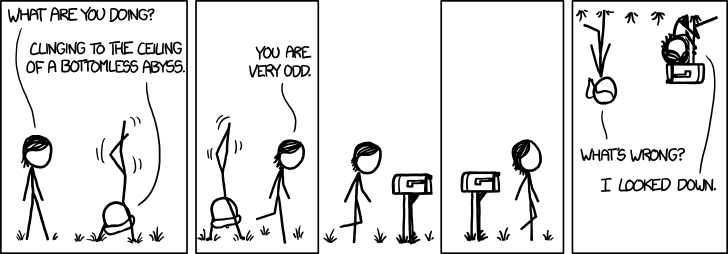
If you don't happen to immediately recognize the comic above I won't judge you. Largely because of this comic:


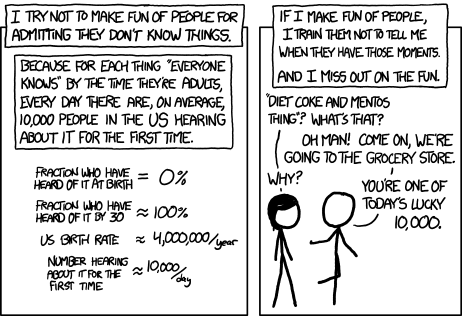
These are recent strips from the phenomenally wonderful webcomic XKCD, which claims to be a comic about romance, sarcasm, math, and language, but is actually about the amazing universe of possibility that all of us inhabit and most of us ignore. But I'll get back to that in a minute.

One of the biggest lies that almost everyone reading this has heard is "you can be anything you want - you just have to work for it." It's a great idea but not everyone can be an astronaut. Most people aren't going to make it as actors or dancers or writers or princesses or artists or even as architects or graphic designers or technical writers. The sad fact of the world is that it needs more data processors than it does ditch diggers, so even the old standby is out.

People talk about my generation as a generation of spoiled, entitled brats. I don't think my generation is particularly entitled, but I do think that my generation was led to expect things that aren't real.

We were told that we would be able to get a great job out of college, which is why we were told to go to college in the first place.

We were told that we "didn't want to work at McDonald's" and so a lot of us are unwilling to take jobs in fast food - largely because the implication through all of our lives has been that working in fast food means you're a failure.

We were told that if we worked hard and put our minds to it, we could do anything we wanted to - but we weren't told that it would take decades working AFTER graduation to move up the ladder and pay dues, all while earning low wages and paying off massive student debts.

We were told that we could "always fall back on teaching" if our field was overloaded, only to find that most of our professors are struggling to get the hours and positions that THEY were promised when they were getting educated, and the line for a tenure position is about a decade long.

We're going out into the working world and complaining that we can't have the jobs we wanted and were specifically educated for because all those jobs are full; we're then told that we're overqualified for the jobs we don't want but can do. "You'd just get bored and leave, or leave if a better offer came along," is the line I heard from potential employers. Well who wouldn't? I've been trained to synthesize vast, disparate fields of knowledge, study information critically and support my findings with evidence and context appropriate to the subject, and the only job I could find that pays well enough to support me is answering phones.

What does that leave us with? Debt, underemployment, dissatisfaction in the workplace, and frustration that the world we were told we just had to work hard for has been denied to us. That's not a sense of entitlement you're seeing in twentysomethings, that's a sense of betrayal.

But just because you probably aren't going to be the next Buzz Aldrin or JK Rowling or Frank Lloyd Wright doesn't mean that you should give up on your dream. You may never get to go to the moon (though seriously, we should get on that - I want commuter flights around the solar system for my grandchildren, dammit) or sign a six-book contract, or build a skyscraper, but that doesn't mean that what you do can't be meaningful to you or to someone else, and even if your work isn't what you REALLY want to be doing there's nothing stopping you from chasing your dreams in your downtime.

Almost none of the writers, actors, musicians, or freak-show performers I know make their living solely based on the art that they love, but all of them make the point to keep up the art anyway. I know a bunch of people in softball, kickball, and roller derby leagues who wanted to be famous, big-name athletes but didn't make the cut. They didn't stop playing sports because they wouldn't be paid for it, they keep playing what they can because sports on the weekends make their weekday lives bearable.

So find a shitty job. Something that pays the bills and bores you to tears and doesn't follow you home. If you wanted to be a writer don't decide that you're going into law because "at least it's something I can do with an English degree" - becoming a lawyer is one of those massive time-sucks that takes over all of your hours and minutes and leaves no time for dreaming. If you studied Chemistry don't become a pharmacist just because "it's at least got SOMETHING to do with my degree." Become a person - a good person - who does your boring, mindless not-in-your-field job well, leaves the office, and then goes home to be a writer. Or a mad scientist. Or an actor or a ballerina or an architect or a graphic designer for a great little magazine that almost nobody reads.

The world may be a terrible place for recent college grads right now, but it's a fantastic place for entrepreneurs. Don't abandon the things that interest you just because you can't find a job where they're relevant; make a part-time job out of them. I don't work for AFLM full time, I don't draw for my income, I don't bake for a business, but I do do all of those things, and they occasionally make me a little bit of money. And I'm holding out hope that something will come from one of them. MAKE something out of the things you care about. Start a small business, write research papers and shop them around to different journals, conduct experiments, draft buildings, translate Greek - whatever it is that you DO and you ARE, do it and be it.

I'm not a receptionist who designs stuff on weekends. I'm a designer who has to work as a receptionist right now. It's all a matter of perspective. The world we live in sucks in a lot of ways, but there are also more opportunities available to us every minute than there were available to our parents every year when they were the same age. We have unique tools and unique skills that allow us as individuals to seek out audiences and find people who appreciate the work that we can do. The world is absolutely alive and teeming with possibilities that we just haven't found yet, and it's our job to go out and look now. Who knows if there's a job out there for a statistics analyst with a background in biology? Is there an employer looking for someone who's familiar with social media and philosophy? Is there a research firm that needs a team of psychologists to pose as waitresses? Who the fuck knows!? Probably all of those things are out there, but its up to us to find those needs and fill those niches.

So look for your joy in unexpected places. If you've got a terrible job make up for it with the time you have outside of work. If you're looking for work remember that just because you're unemployed doesn't mean you can't do anything - build your portfolio or write a children's book or start studying up on biochemistry. Learn a programming language and combine your field with the wide wonders of the web. Find something that drives you, even if you're a long time looking. Look down some day and ask yourself if you aren't really looking up at a universe you've never considered.

Be excellent to each other.
Cheers,
     - Alli

Sunday, October 7, 2012

An Education in Rhetoric


After a few classes in History of Rhetoric, I find myself questioning the validity and importance of classical rhetoric.  I read an essay last week which explained the history of the study of classical rhetoric in the academic curriculum and how it was disregarded for a long time.  Rhetoricians, professors and scholars had to fight to get classical rhetoric back into the curriculum and to be seen as important as Literature.  Now, luckily, rhetoric has had a revival back into the curriculum, but the essay made it quite clear that the people who are fighting to keep rhetoric into the academic realm must continue to fight.

This fight for classical rhetoric being taken seriously as both a theory and practice really struck a chord with me.  Although I haven’t had much schooling in rhetoric thus far, I do understand its importance in the curriculum.  So, I have to question, how key is introducing rhetoric into the curriculum for high school students?  In high school, we learned the fundamentals of writing and writing well, reading with comprehension, and being able to speak our minds about a certain literary text.  However, in my experience, I was not exposed to rhetoric or to the importance of debate and orality.  Having said that, I personally feel that as writers and fighters for communication and its validity, rhetoric is a key component in establishing oral skills. 

As much as I believe that literature and writing are crucial within the classroom, not focusing on speech/debate can be problematic in the future.  As we listen to the debates amongst the candidates, we must listen to their speeches rhetorically:  How are they addressing the audience?  What specific kinds of tactics are they using in order to “sway” voters?  These questions arise when I watch the debates and for the most part, it is the study of rhetoric that is aiding me into asking the right questions and answering them.  For this purpose, along with many others, we need to bring in more rhetoric (theory and practice) into the curriculum, especially, in my opinion, in high school.  I feel, along with many others that critical thinking and analytical thought has diminished partly due to standardized testing, and with that, our students are not given the proper tools to learn how to think for themselves (something much needed at the university level and in life, in general). 

So, I end with a question: what is the validity of rhetoric (especially classical) being taught in the classroom and how much of it should be a focus?

Saturday, October 6, 2012

Sometimes You Don't Have a Choice


I just finished my first paper of the quarter. The weird thing is writing gets harder. You’d think that as you practice it would get easier. Somehow it would become habitual, something you could just aimlessly do in your sleep. But it doesn’t. You think about it more. As you read more you realize how strange your sentences sound. Everything feels awkward, inadequate. You also become more intellectually invested in whatever it is you're writing about. As your understanding of the material increases, so does the need for you to accurately depict or capture those moving revelations.

 It’s as if texts become complex people. You begin developing these entangled relationships. You can’t just say “Hey, this is Joe. He’s an okay guy.” You’ve gotta sit with him. Get inside his head. Maybe you hold him tenderly. Maybe you wrestle with him at 3 a.m. But you see what makes him tick and come to understand that you will never be able to pin down why and how Joe is who he is. That revelation is both fascinating and terrifying. He simply can’t be reduced to one-dimensional terms. Which makes you question if you will ever achieve success? Nevertheless, you try to reveal at least one aspect. You try to show the world why he is great. Why he is deplorable. How others can relate to him. Why anyone should give a damn, all in the hopes that you can pass on why Joe moved you in the first place. So, it isn’t just something you have to do to meet a deadline, but sometimes it is something you MUST do it. Because if you don’t, it isn’t about getting a crummy grade or impressing your peers, it’s about not honoring that relationship. It’s because you won’t be able to sleep until you do that person justice. Joe simply won’t leave you the fuck alone. You can go to BJ’s and drink a beer or two. But he is still there. Waiting.

So, ya. It gets harder. But it feels damn good when Joe finally gets off your back.

Friday, October 5, 2012

On Eco-Criticism


For those of you who don’t know me, and I’m assuming that might constitute a majority of people who read this, I’m not the hugest fan of eco-criticism; I don’t think I hate it, but, then again, I think it is a bit odd – a square peg in a round hole of literary criticism, if you will.  Now before we get started, don’t get my wrong; I have many colleagues who are into eco-criticism, all of whom are extremely intelligent folks (the top two who come to mind are my dear friends Steve Zelt and MP Jones), and all of whom shed some interesting light on literature. For some reason, though, I just haven’t been able to get into it or take it overly seriously.  However, I think I might start thinking about it differently – and, perhaps – I don’t claim to know what you think, not for the reasons you might think.

Right now I’m half watching Real Time with Bill Maher. The special guest tonight, Bill McKibben, is an environmentalist activist who attended school at Harvard. He is a Guggenheim Fellow, a Lyndhurst Fellow, and fellow at the Post Carbon Institute, among others – not to mention he has honorary degrees from Marlboro, Colgate, and NYU, etc. The reason I bring this up is because I’m watching in horror at the way he is being treated. He is one of the leading minds in environmental activism (his publishing record is a testament to that claim) and Bill Maher’s panel is not taking him seriously.  

Now, you might think to yourselves, “what exactly does this have to do with eco-criticism in literature?” I realize that the connection may be a bit tenuous; however, I think that people need to take seriously what certain specialized people, people such as Bill McKibben, have to say about the environment. McKibben talked extensively about the insane weather we’ve been experiencing on a global level, only to be met with doubt and pejorative quips.

The truth is, scientists and activists are trained to analyze a myriad of data, and the derivations of said data are not flippant claims – they are hypotheses that, through intensive testing and peer-peer review, become theories (Richard Dawkins says we ought to look at, I believe, the second O.E.D. definition of theory when we look at this word; in fact, the word could very well be “theorem”). Said theories create a framework by which we understand the world.

Now the question I would like to ask is this: what exactly is it that the layman knows that the scientist and environmental activist do not? I would suggest that they know nothing in comparison. With that being said, I will now talk about eco-criticism.

Although the people who study eco-criticism tend to be well-educated liberals, I know that the entire readership of eco-critical papers is not limited to said group. Because of this – I apologize if this is not, though I believe it is – fact, I believe eco-criticism serves an invaluable purpose. People ought to be exposed to the issues of the environment; and, if we can further educate the already educated, we can better arm an elite populace of minds to better combat the ever-growing presence of scientific doubt – and, through this action, we may be able to better address environmental issues, even if we are not scientists.

So, for those of you out there studying eco-criticism, keep on keeping on. And for those of you (like myself, admittedly) who may not take eco-criticism seriously, I urge you to look at its utility. It is not the theory of choice I’d go to first – I’m more of a formalist and new-critic, actually – but I now see that it does, in fact, serve a potentially crucial role in the academic world. The environment is all we have, folks; and, for all you Romantics, it makes Wordsworth turn over in his grave when you fuck with it.  

Thursday, October 4, 2012

Rapists, Seducers, and Harassers! Sounds like a presidential debate to me

As everyone knows and some saw, the first of the presidential debates took place last night in Colorado and was broadcast live for the viewing pleasure, and oftentimes disgruntlement, of the entire country. 

For me, CSPAN's live stream of the debate presented an interesting opportunity.  Without forethought at the beginning of a busy semester, I had scheduled a brief debate unit for last week for my freshman English students. 

As things wrapped up last week and I realized that the first presidential debates were scheduled to take place last night, I decided to live steam it to my class as it would be airing for a 90 minute portion of one of our 4.5 hour sessions. 

This ended up being way more entertaining than I had expected, and I suspect quite a bit more entertaining than my students had anticipated. 

When covering debate last week, I referred to an article that Alli suggested to me a few months back: Wayne Brockriede's "Arguers as Lovers." In this piece from 1972, Brockriede details the types of argument using the analogy of various kinds of sexual relationships: rapist, seducer, lover. In 2000, Jay VerLinden expanded on these analogies by adding "arguer as harasser" to the mix. 


As you may already know or suspect, an "arguer as rapist" is generally not considered a good thing and is for the most part to be avoided, particularly in academic or generally intelligent debates. The example we looked at in class of someone who is generally rapy in his argument style was Bill O'Reilly; we discussed his penchant for forcefully talking over his guests and for attacking the arguer not the argument. These are considered primary tropes of the "arguer as rapist."

The "arguer as seducer" is basically anyone who, while arguing or debating, appears charming, genial, and considerate, but is in fact fabricating information, misquoting, misrepresenting facts, or otherwise being dishonest. Paul Ryan, anyone? His demeanor is charming...and he doesn't like fact checkers. 

The "arguer as harasser" is exemplified by undermining of an opponent by lightly provoking them or distracting them and the audience, when there is one, with deriding humor. Paired with O'Reilly, our friendly neighborhood arguer rapist, is Jon Stewart as our harassing arguer. Though this form of argument is still generally frowned upon in academia, you'll see if you watch the video clip below that it can be quite effective. 

And last but by no means least is the "arguer as lover."  This for all intents and purposes is the ideal arguer and if you can get two of them together, or at least two people who utilize the lover tactics and approaches far more often than the other options, you can have a truly informative and constructive debate. The only example I could find of a debate that is strongly based in the ideal of argument for understanding and not for dominance is one between Richard Dawkins and Rowan Williams Archbishop of Canterbury. It's just difficult to find Americans doing this. 

And that brings us back to the presidential debates.  What I asked my students to do while we watched last night was to keep a record of tactics, approaches, and aspects that could fall into one of the four categories.  

What they saw and discussed with one another and with me was quite different from what the general media, both liberal and conservative, claims to have seen. I was shocked and confused this morning to see the yahoo news update and to hear the post-debate coverage on NPR. What debate were they watching? I wondered. 

The media, and many Facebook friends, spent late last night and the rest of today declaring Romney had "won" the debate. That word choice should have been my first clue that the majority of the country was not watching last night's debate through the same lenses my students and I had been.  

While the rest of the country found Romney's fast talk to be charming and engaged, the majority of my students saw a man all too comfortable to use rapist strategies to silence the moderator and keep his turn as long as possible, seemingly in part to assert his dominance. And while the rest of the country saw Obama's slower, methodical responses to be a sign of disengagement and perhaps a lack of preparation, my students saw him using lots of harasser tactics, with virtually every of the president's responses intro-ed with an undermining quip at Mitt. 

We all agreed that Obama made some real mistakes, mostly by not jumping on more of the inconsistencies voiced by Romney; however, everyone felt, regardless of political affiliation, that Obama had presented himself more favorably by seemingly using mores numbers and facts, by staying more often on topic, and by not jumping at every chance he got to needlessly dominate the moderator (with the exception of that one very bad moment...which I could write a whole other blog post about). 

So it seems that all this talk about Romney being a better debater is more than anything referring to the impression he gave the audience that he is jovial, interactive, and dominating.  Domination- rather than discussion and clear presentation of facts and details- of an opponent in a debate is not what my students have been trained to look for and value; they were looking for someone who considers what the other person has to say and contemplates his response with claims and facts.  That's not too much to ask- its just the rules of a proper debate, it's just the ones we should all care about.  Otherwise why don't we just have Bill O'Reilly and Jon Stewart moderate next time?  That will be the show we all seem to want.  

http://www.youtube.com/watch?v=Im8WhG-8FGw

http://www.youtube.com/watch?v=HfQk4NfW7g0