
Wednesday, May 2, 2012
Building Your Writing Toolkit: Part 7 - Voice as Stain

Monday, April 16, 2012
A Novel Idea Part 4: iFrame
I want to take a slight detour before I get into the structure of a frame.
This past Saturday was our one year anniversary. There are a lot of things that have changed over the course of this year. We have added more people to the original four. We have a blog, an online store, and a publishing company. We're on Facebook and Twitter. We've hosted open mics, book launches and late-night meetings fueled by caffeine.
But through all of these changes, our commitment to bringing you the best pieces of Individual Expression has not wavered. We are still a collective of human thought and insight and continue to strive to bring you the best product possible.
We seek to continue our goal of bringing people together in multiple mediums so that they may have meaningful conversations.
I want to end this by thanking all of the people that have made this possible, and for all of you who continue to read and share this magazine.
Thank you.
Now, onto Framing.
So below I have posted a photograph of what a page from my notebook looks like.
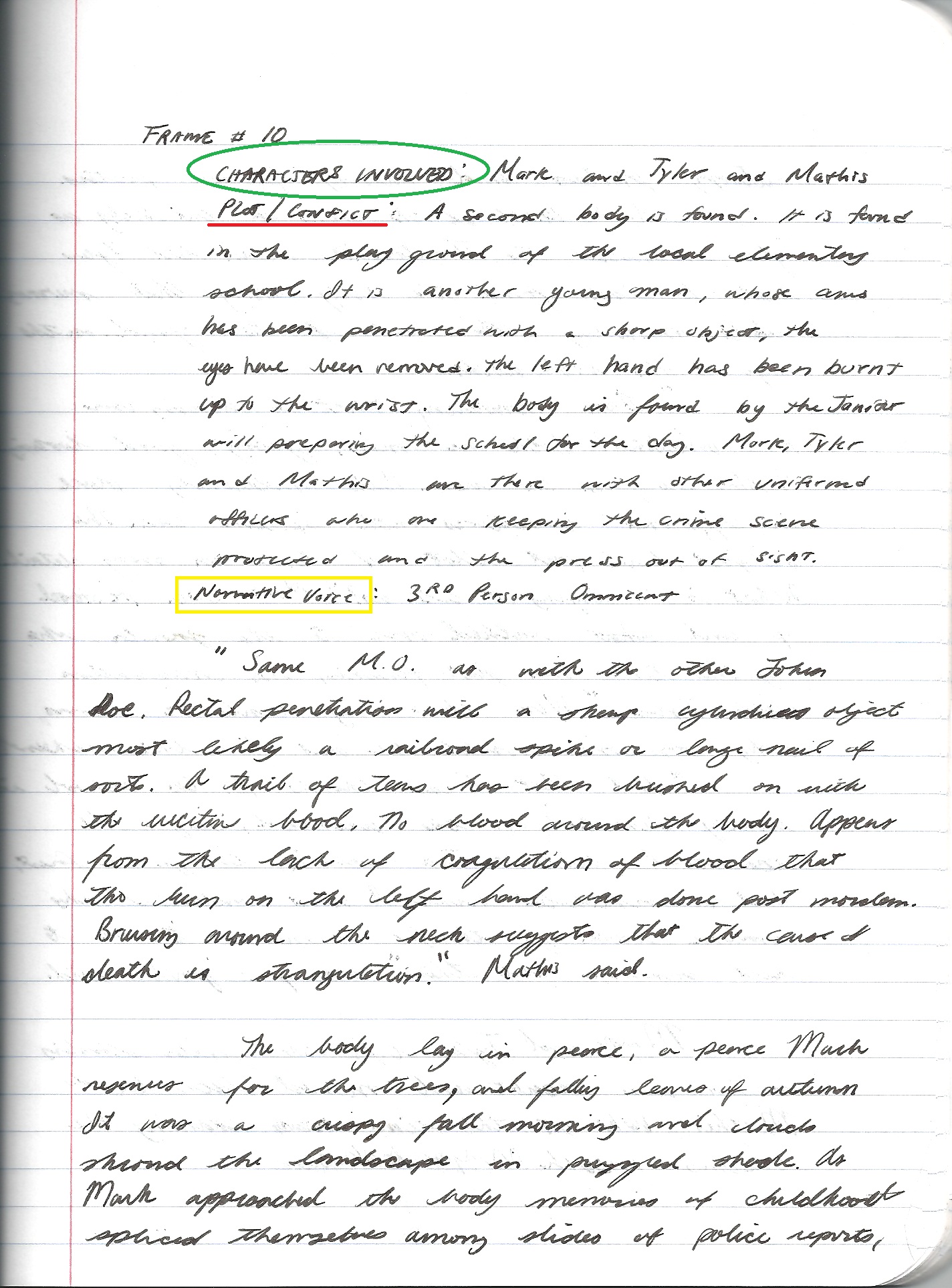
There are three key features that I would like to point out and each is marked by a different color and shape. Each color coded section refers to a different question I ask myself before I start any frame.
Who are the characters involved? What is the plot/conflict? What is the narrative voice?
By asking these questions I give myself a clear path to follow and it makes getting a few lines onto the page a little easier.
The first section, "Characters Involved" circled in green, helps not only to get you thinking about the who of a frame but allows you to group related frames quickly and easily.
The last section, "Narrative Voice" highlighted by a yellow rectangle, is important because it makes it explicit how the narrative is going to be told. In my frames I have used several narrative voices. For example Jacob's narrative is told in 1st person while Mark's narrative is told in 3rd person witness. I have also tried experimenting with narrative voices.
A new voice I am experimenting with is for William's narrative. I call it 1st person witness testimony (I'm sure there's some fancy literary term for this, but I'm a Law Student so please humor me). In this narrative voice there is no dialogue. Everything we get is from one person's mouth and by that fact hearsay. But what will make this narrative voice work will be the frames before this one. If I put frames before this that make William seem sympathetic then you will be more inclined to believe what he says. If I have a frame before this one where he is cheating on his wife, then you are less inclined to believe him.
The most important part of the Frame outline by far is the Plot/Conflict section underlined in red. This section helps me avoid writing meaningless details in the body of the frame which only serve to distract from the dialogue and narrative. This section also helps me to keep the pacing of the frame quick.
One additional benefit of writing out the Plot/Conflict before hand is that if I have to step away from my writing I already have a summary or rather an abstract of what the frame is going to be doing so I can quickly pick it up.
It' s important though to remember that just because you have outlined it in your Plot/Conflict section doesn't mean you have to follow it strictly in the body of the frame. The Plot/Conflict section is more of a guide to follow and is meant to help you. It should not be treated as though written in stone.
Remember, inconsistencies in your Frames are fine, and I would argue that they are preferable. These nuances and slight variations allow you to explore multiple ripples in the time/space fabric of your ever evolving world. These wrinkles will be ironed out in subsequent drafts so don't slow down your writing by trying to solve everything now.
Well, that's it for this week. Next time I am going to be finishing the second part of Framing and discussing how your Frames should work within their respective local narrative as well as the over-arching narrative.
Until next time,
As always
Undoubtedly Yours,
Bermuda the Man
Monday, April 9, 2012
A Novel Idea Part 3: Your Writing Road-map
The novel is progressing and the characters are inviting me into their world. I am currently done with 30 frames of my 50 frame goal.
And with that I reach the topic of my blog this week: Having a plan of attack for your novel. Establishing a series of goals and checkpoints that allow you to mark tangible progress in your novel writing process.
But before I get into my writing road-map, I wanted to discuss how I am breaking away from the social norm of how most authors think about writing a novel. Where most authors see themselves as writing a book, I am going about it as though I am writing a screenplay.
A screen play has limited narration, simple stage directions and thus is mostly dialogue. This allows the director more freedom to create the film how he sees it and not how the writer envisioned it himself. Which sounds more user friendly given that in the Novel-land, the director is analogous to the reader and the screenwriter analogous to the page-writer.
When writing your first draft, I find this approach, putting less attention on the details and more attention to the character-narrative, not only more desirable but also healthier.
It is more desirable in the sense that you are able to get through many different frames without being bogged down in one particular part of the story. By not being concerned with every little detail of your narrative the first time through, you don't have to worry about contradictions that will inevitably show up through out the frames of your first draft as you get deeper and deeper into the local narrative. This type of drafting is also healthier than the traditional A to Z appoarch because you are able to amass a large amount of clay from which you can shape subsequent drafts. You don't get lost in a narrative and then end up giving up because you can't decided whether your heroine is wearing all black, or white lace and how this will impact the rest of the novel. You don't feel like you have to answer all of your Narrative's questions or tie up all of the loose ends in a given chapter.
REMEMBER:
Always leave more to write.
So now on to my road-map.
Like any long, continuous project, it is important to have goals. Not only does it give you a sense of accomplishment but it also gives you a way of holding yourself accountable. By giving yourself steps, you are more likely to make it to the next level, no matter what the endeavor.
My first goal is to get to 50 frames.
Why 50?
I chose 50 for several reasons. First, it gives me a large amount of clay to work with and shape. Second it was a large number that, while obtainable, would require dedication and commitment to reach. It should be noted that my novel will more than likely consist of more than 50 frames.
Frames are awesome Bermuda, but how long is it going to be? How many words do you have written?
A friend asked me these same questions and you know what, I told him this:
I have no idea.
And you know what else, I particularly dislike that way of thinking for a lot of reasons but the major one is because thinking about writing length in terms of word count is very demoralizing and limits yourself in the early stages of your writing process. I would much rather think of a goal in terms of writing frames rather than writing words. The smaller number of frames relative to the tens of thousands of words in a novel makes me feel like I can achieve my goals and makes the project seem less daunting. Another reason this way of this is detrimental is that it limits you. Don't worry about length, about making it this long or this short, just write until the narrative tells you she's all done.
Alright, Respect. So, what do you do when you have all your frames?
After I've finished the 50 frames, I am going to type all of them into my computer. As I mentioned in Part 2 of this series, the act of typing is in essence a revising step. Once all of the frames have been typed/revised, then each of the frames gets a title.
The title will then be placed on an index card. Much like a story board I will then place frames out until I have a straight forward narrative. This step is important because I don't write the frames in a linear fashion. Frame #23 and Frame# 24 for example are not apart of the same local narrative. By laying out each local narrative, I am able to see the holes or rather gaps in each of them. Once the gaps have been identified, I can begin the third draft which will consist for the most part of me filling the gaps in each of the three local narratives I have in the novel and shaping smooth transitions between frames of a given local narrative.
Once the local narratives have been laid out and frames have been added to plug the holes, all of the frames now get put on another round of flash cards same as before. Each with a title for the frame. This is where the magic happens. This is where you weave the three local narratives into your main over-arching narrative. This is where you will spend most of the time editing; moving this and that in an effort to create a tempo for your novel that maximizes the meaning.
Well that's it for this week, my Fellow Contributors.
REMEMBER: set goals for yourself that are obtainable and challenging. By breaking up your writing process into steps, you'll be surprised when your standing on top looking down on the world as they read your finished novel.
Next week I am going to be posting a picture of my actual notebook and going over the structure of a Frame. What should it include, what the structure is like, how long it should be and how it should function in relation to the local and main narratives.
As Always
Undoubtedly Your,
Bermuda
Tuesday, March 13, 2012
There are no conversations with the dead
Tuesday, January 24, 2012
Some Perspective for Reading Poetry & Some Better Advice
With our reading at Coffee Klatch right around the corner, I thought it would be fitting to post a blog about reading poetry. Don't get me wrong; our last reading was wonderful, and I have absolutely no complaints. I hope that all of our guests from the last reading will meet with us again this Friday – including our “occupationally challenged” friend, Phishfoot (a homeless man who contributed a great reading last time). My inspiration for this blog on reading poetry definitely did not come from our last reading. My inspiration comes from nearly every time that a teacher of mine has asked the class for a brave volunteer to read a poem aloud; it comes from nearly every time that that brave student has propped up their book, cleared their throat, and let spill a monotonous stream of words from their mouth, not even stopping, just plowing through the page as if line breaks meant nothing and as if punctuation were only for grammar's sake. I understand that it is extremely difficult to perform a poem unrehearsed and that it truly is courageous to attempt to tackle a performance in front of peers, and I respect those individuals who try, but I still wish that students who don’t know how to pronounce the word, “bough,” would refrain from raising their hands to read.
This blog isn’t really about those students though… It’s about poetry in general. Please remember, I’m no professional, and I won’t be teaching a lesson on performance today. What I’d like to offer instead is a bit of perspective:
A poem, once removed from its author and placed on paper, dies. The poet doesn’t shadow his/her poem, following it where ever it falls; the poem is left alone as its own lifeless entity. The dead poem drifts around the world, attached to paper as ink blot symbols. Its lifeless body is left to the whims of its readers.
To a poem, a reader is a god. The reader breathes into the dead poem and brings it to life with his/her performance. Whether that performance is silent, existing within the mind of the reader, or aloud to an audience, the poem lives for a brief moment as an expression of thought. The reader controls what a poem will become.
Please, for the sake of Walt, show poetry respect. If you are to give life to a poem, then give it a respectable life. Take notice of what it wants to be, of what signals it has left for you. Be a loving god, and breathe into it with compassion for its author and its message, and if you happen to think that the author and the message can suck eggs, then give it a life you see more fitting for it. And never never never read a poem as a monotonous string of sound – unless, of course, you can argue why you gave it that life.
So there it is. That’s my perspective and a little bit of advice. If you’ve read all of that, and realized that you want something other than a college kid’s opinion, then I hope you enjoy this:
I think the bard said it best.
Wednesday, November 16, 2011
Finding Forms of Language (and listening to some dope music)
So far in college I’ve never received an assignment that I’ve absolutely hated. I’ve always accepted whatever it is that I have to do, and, even if I have to stay up for a few days straight, I do it happily. I like that rush of progress that comes from working on a challenging paper… But with all that said, I think this paper that I recently received in my Shakespeare course has to be at the top of my list of least favorites.
Let me complain for a second:
I had to write 4 mini-essays (150-250 words), which each focused on a different moment in some of Shakespeare’s plays. Sounds easy enough, right? My task was “to make explicit what is implicit in the play” – I was actually pretty excited about the project until I got to the part where the professor spelled out how each one of the mini-essays should be laid out. He wanted the first sentence to be this, and the second to be that, and so on…
I know it doesn’t seem like a big deal, but I was initially pissed that some “Shakes-pe-herian” was trying to tell me how to formulate my thoughts. I am a writer because I love the freedom of creation. To me, writers are like the Green Lanterns of Literature (<--let’s see who gets the comic-book reference). Basically, what I’m saying is that my work is nothing more than my thoughts manifested in exactly the way that I see fit for them to be presented – all of my choices are my own. From the start, I knew this assignment was going to be hell for me.
I struggled with the assignment, and I hated every second of it; every sentence that I had to write twisted me up inside... but after 2 all-nighters, caffeinated and frustrated, I noticed the title of the handout that my professor had given me, "The Commentary Form", and I had an extremely helpful realization: the true artist of language can manipulate his thoughts into any form, be it a piece of flash-fiction or creative non-fiction, a poem, a biography, or a novel... or even an assignment. A great writer works to manipulate the language within the structural setting of the form.
I sat and thought for a while, and I was amazed at all of the different forms I could think of. Even within the form of poetry there are countless different types of poems, and each type of poem has its own structural identity that allows the language in it to be compared and contrasted with other poems of the same type. I guess in terms of Literary Theory, I got to experience structuralist theory at it's best at about 3:30 in the morning.
The idea stayed fresh in my mind for a few days, and I began applying the theory to things other than writing.. I'd like to leave you with what I think is one of the forms that I enjoy the most. I don't really know if this form already has a name, so I'll just call it the "Assumed-Role Poetic Flash-Fiction Form" (please, help me with a better name, because that one sucks).
And she treats me like some type of common vagrant
I see her everyday, but there's nothing to say
Unless I decide to step inside of that cafe
I only get to sit if I buy something to eat
Otherwise it's best to keep my feet moving down that street
And god damn she's a hard bitch
Talks at me like I'm the bad dog that got into the garbage
Yeah I know that the toilet is for customers
You ain't got to tangle up the strings to make this puppet work
It doesn't have to be a game of patty cake
But it ain't like you don't know I sleep in that alleyway
And by the way, I can see it in your eyes
You're angry with your life, not a stranger to the fight
I bet you hate every man that you date
And you're probably addicted to all types of escape
You take it out on me that you're all alone
When you know you got your own closet full of hollow bones
Watch the tone when you speak to old folks
I'm grown, just trying to get out of this Minnesota cold
[ Lyrics from: http://www.lyricsmode.com/lyrics/a/atmosphere/the_waitress.html ]
Look lady, I'm homeless, I'm crazy
I'm so hopeless I'm suicidal daily
If you and I can't co-exist, let's fake it
Cause I ain't got the energy it takes for this relationship
I'm waiting for a city bus to flatten me
And transport me to the ever after happily
Maybe reincarnate and with luck
Come back to Earth as a cockroach in your tip cup
She said she's had it up to here
She's gonna call authorities if I don't disappear
I love her threats, it rejuvenates my breath
I give her stress for the reaction that it gets
I got a pocket full of pan-handled money
On a cup of bad coffee and a stale honey bun
In front of everyone she calls me bum
But she notices my absence on them afternoons I don't come
So here I am, thorn in her hip
Holding down the corner table all morning with some corn chips
Ignoring the insults and evil eyes
I feed off of 'em, I wonder when she'll realize
That she's the only reason I visit
The only woman in my world that acknowledges my existence
And if my ship ever comes, I'll miss it
Because I'm getting old and I ain't got much left to give it
So there it is and I have to live with it
I had the chance to make a difference, but I didn't
In the cafe bathroom drinking free tap water
Thinking: "Damn, I should've been a better father to my daughter"
Until next time,
S.Pine