Tuesday, July 31, 2012
When Words Speak Pt 3: Character Shifts
Wednesday, July 18, 2012
When Words Speak Pt 2: Pausing
Tuesday, June 12, 2012
Letter To the Leaves: God Does Exist. And It's Spelled W-E
One of the books I am reading at this time is Eckhart Tolle's book, The Power of Now. This book was actually recommend to me by Slick a few months ago and I have been devouring it every since. The tagline for the book is, "A Guide to Spiritual Enlightenment". I recommend it to everyone who is searching for their own inner voice and presence.
I bring this book up not to discuss philosophies, but because their is a section of the book that I feel resonates with what I have discussed in several of my previous blogs.
Here is the section I want to point at today,
"Don't get stuck on the level of words. A word is no more than a means to and end. It's an abstraction. Not unlike a signpost, it points beyond itself. The word honey isn't honey. You can study and talk about honey for as long as you like, but you won't really know it until you taste it. After you have tasted it, the word becomes less important to you. You won't be attached to it anymore. Similarly, you can talk or think about God continuously for the rest of you life, but does that mean you know or have even glimpsed the reality to which the word points? It really is no more than an obsessive attachment to a signpost, a mental idol....
...If you had a strong aversion to the word God, which is a negative form of attachment, you may be denying not just the word but also the reality to which it points. You would be cutting yourself off from the possibility of experiencing that reality."
Jack and I were having a conversation after the last open mic. You see he's been writing a bunch of physics poetry lately and asked me if I believed in God. I told him, that I was raised Roman Catholic and my views aren't as simple as whether or not there is a God. I told him that I view organized religion as a medium through which I can find my spiritual enlightenment or presence.
In rebuttal he told me that I had to acknowledge that science is the only universal truth. That God is only used as a weapon against groups and that it is worth not believing in because it is only used for evil. He told me that he was raised christian but has now come to the realization that there is not a God.
I read the passage from The Power of Now after this conversation, and felt that these were a few lines I should have quoted in defense of my position.
The way I see it, God is only a signpost used to get everyone connected to a universal truth. Jack, and other people like him, are asking the wrong question. Its not whether there is a God, but why would a God be created.
I was doing some research for an article on the relationship between business and religion. In my research I came across an article about Karl Marx. He held the view that God was created by men, and was used to keep the laborer in the chains of the capitalist. I agree with Marx in one respect, that God was created (the word and the way its delivered) but rather than a means of oppression it is a means of liberation.
It is a way for all of us to "be on the same page"; to focus our attention on one idea. Rather than getting caught up in the how of religion, we need to get focused on the Now of religion. The feeling that it makes us experience and the sense of freedom, warmth, love, and tenderness it opens us up to feeling.
So don't get caught up in words. Don't get caught up in other peoples opinions or in their religion. Everyone is searching for the universal truth. They are searching for their own god-essence and they are teaching us that we are all connected.
Physics, God, Science or Religion. These are only tools teaching us to transcend.
As Always
Undoubtedly Yours,
Bermuda the Man

Tuesday, May 22, 2012
Letter To The Leaves: The Art of the Flow
I first want to point out that our fourth issue, and the last of volume one, hit the intangible shelves of the internet today. I want to give a big thanks to everyone on the masthead, our readers and our contributors. Without your dedication, diligence and love, this issue (which I must say is our best yet) would not have ended this chapter of our magazines story on such a high note.
Now with that said, back to the topic at hand.
My goal with this blog is not to give you my "definition" of what Flowetry is. Rather I hope to start a dialogue between us in hopes of exploring this medium together.
At first glance it is easy to see the etymology of the word. There are two parts of the word. The first part of the word is Flow and the second is -etry coming from the word poetry. From this dissection I get two ideas right off the bat.
My first idea points out the fact that the art of Flowing is a dynamic, powerful, and exciting medium through which to enjoy the spoken word. When my friends and I circle up at a party or even around a camp fire and drop a track to spit on, we are doing the same thing the bards were doing in ancient Greece when they circled up and recited a few lines from the Odyssey. We are creating a story; stringing together words on a beat in such a way that they are pleasing to the ear. It must be noted before I continue that Flowing goes far beyond hip hop or any other musical connotation.
When I flow, it is a largely spontaneous mental exercise. I have no idea what I am going to say or what I am going to flow about next until I begin to speak. One word feeds the next, which feeds the next and so on.
The second idea encompasses the last part of the word, -etry and by extension poetry. In this part of the medium notions such as meter, rhythm, content, rhyme scheme and form come into account. Where flowing is largely spontaneous, poetry is more about revising. It is about working through the inconsistencies of symbolism and theme. It is where the skill of the writer is put to the test and shown off.
But you see, just ranting off a few drunk lines at a party, that just happen to rhyme, doesn't make you a strong poet. Just like writing, preparing, and reading a poem to a crowd doesn't make you an M/C. What you need is bravado, presence, confidence, and dedication. What you need is a medium which can combine these two and create a new way of enjoying the spoken word.
And when we put these two together we get such a medium. A medium which is both dynamic and structured. Chaotic and fluid. This medium resonates with a particular population of poets who are looking for a way of expressing their words in such a way that captures and holds the attention of their audience.
It is a way of weaving words in such a way that whirl in the wind of your audience.
Play music with words and paint pictures with sounds. Share your voice.
And now its time for you to share your thoughts are on the subject.
Please and Thank You.
As Always
Undoubtedly Yours,
Bermuda the Man
p.s.
Be. Do. Share.
Monday, April 16, 2012
A Novel Idea Part 4: iFrame
I want to take a slight detour before I get into the structure of a frame.
This past Saturday was our one year anniversary. There are a lot of things that have changed over the course of this year. We have added more people to the original four. We have a blog, an online store, and a publishing company. We're on Facebook and Twitter. We've hosted open mics, book launches and late-night meetings fueled by caffeine.
But through all of these changes, our commitment to bringing you the best pieces of Individual Expression has not wavered. We are still a collective of human thought and insight and continue to strive to bring you the best product possible.
We seek to continue our goal of bringing people together in multiple mediums so that they may have meaningful conversations.
I want to end this by thanking all of the people that have made this possible, and for all of you who continue to read and share this magazine.
Thank you.
Now, onto Framing.
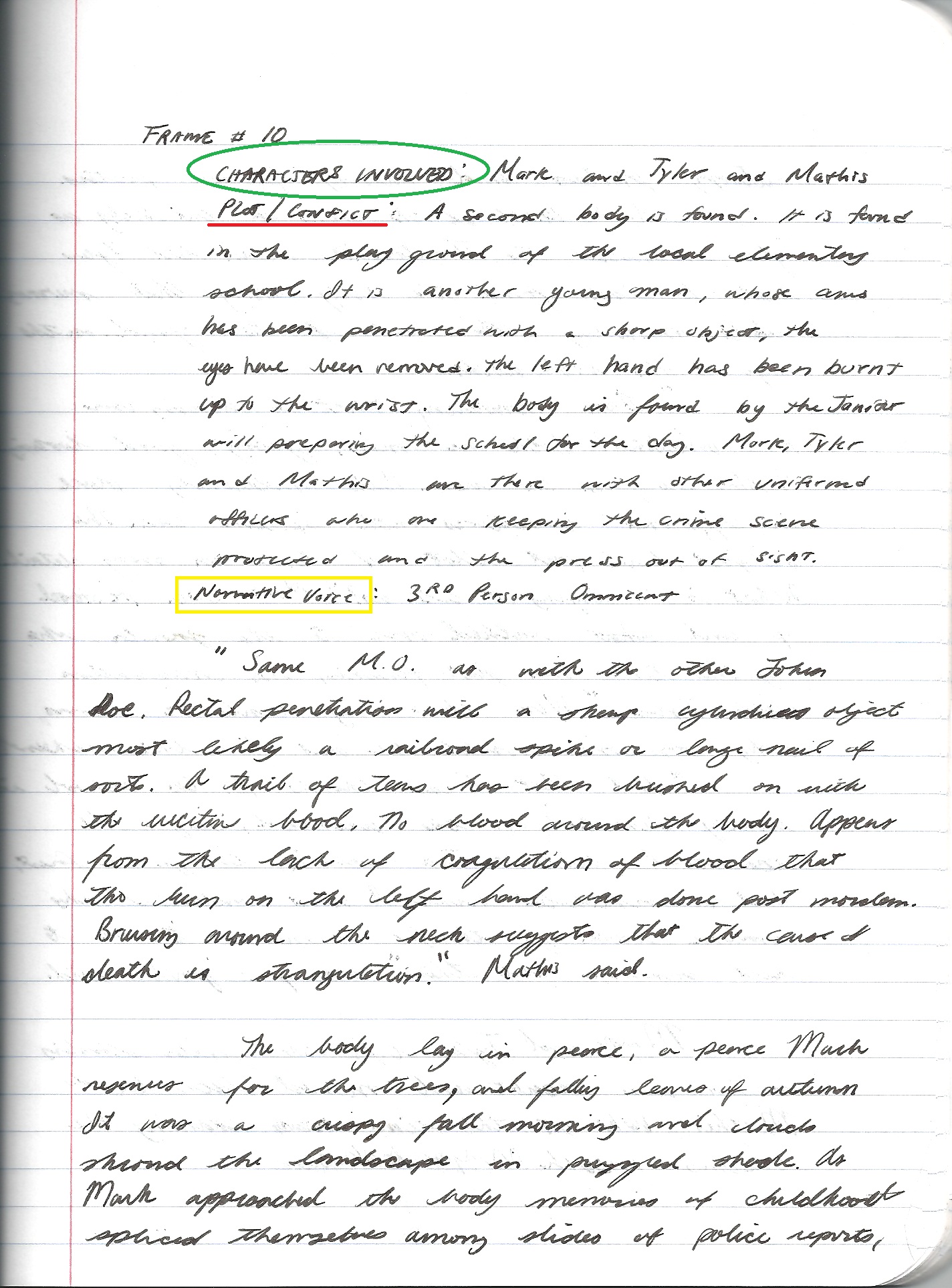
So below I have posted a photograph of what a page from my notebook looks like.
There are three key features that I would like to point out and each is marked by a different color and shape. Each color coded section refers to a different question I ask myself before I start any frame.
Who are the characters involved? What is the plot/conflict? What is the narrative voice?
By asking these questions I give myself a clear path to follow and it makes getting a few lines onto the page a little easier.
The first section, "Characters Involved" circled in green, helps not only to get you thinking about the who of a frame but allows you to group related frames quickly and easily.
The last section, "Narrative Voice" highlighted by a yellow rectangle, is important because it makes it explicit how the narrative is going to be told. In my frames I have used several narrative voices. For example Jacob's narrative is told in 1st person while Mark's narrative is told in 3rd person witness. I have also tried experimenting with narrative voices.
A new voice I am experimenting with is for William's narrative. I call it 1st person witness testimony (I'm sure there's some fancy literary term for this, but I'm a Law Student so please humor me). In this narrative voice there is no dialogue. Everything we get is from one person's mouth and by that fact hearsay. But what will make this narrative voice work will be the frames before this one. If I put frames before this that make William seem sympathetic then you will be more inclined to believe what he says. If I have a frame before this one where he is cheating on his wife, then you are less inclined to believe him.
The most important part of the Frame outline by far is the Plot/Conflict section underlined in red. This section helps me avoid writing meaningless details in the body of the frame which only serve to distract from the dialogue and narrative. This section also helps me to keep the pacing of the frame quick.
One additional benefit of writing out the Plot/Conflict before hand is that if I have to step away from my writing I already have a summary or rather an abstract of what the frame is going to be doing so I can quickly pick it up.
It' s important though to remember that just because you have outlined it in your Plot/Conflict section doesn't mean you have to follow it strictly in the body of the frame. The Plot/Conflict section is more of a guide to follow and is meant to help you. It should not be treated as though written in stone.
Remember, inconsistencies in your Frames are fine, and I would argue that they are preferable. These nuances and slight variations allow you to explore multiple ripples in the time/space fabric of your ever evolving world. These wrinkles will be ironed out in subsequent drafts so don't slow down your writing by trying to solve everything now.
Well, that's it for this week. Next time I am going to be finishing the second part of Framing and discussing how your Frames should work within their respective local narrative as well as the over-arching narrative.
Until next time,
As always
Undoubtedly Yours,
Bermuda the Man
Saturday, March 3, 2012
Letter To The Leaves: Every Novel Begins With A Few Lines
My Fellow Contributors,
I must admit something that I have been reluctant to tell many. I am a victim of our modern technological era. It seems in our time of status updates and tweets I have become trapped in writing in 150 character thought blocks. My ability to write long cohesive stories has deteriorated. Or perhaps it would be more accurate stated this way: my motivation to write long cohesive stories has eroded.
William Winfield Wright stated last week during the Q&A section of his reading that he loved titles and endings and that short poems let him get to both quickly. Short poems are like Polaroid snap shots. They capture one scene in all its glory. Every minute detail is allowed to rise to the surface. There is truly something to be valued in how much can be said in just a few lines.
But as a good friend of mine reminded me the other day, there is also something to be valued (if not more) in a long sustained novel. This friend said that it was amazing that someone could concentrate and manipulate ideas over the course of three hundred pages.
I suppose I agree with her. It is quite the feat that a writer could spend the amount of time and thought necessary to produce such a work. I might even go as far as my friend did and say that it is more impressive than say a collection of poems. However, I'm not one for sitting down for long sustained periods of writing. I find it hard to sit down and write papers for school let alone sitting down to write a novel. And the thought of developing a story that could last over two hundred pages is intimidating. But even with these reasons, I still haven’t been stopped from trying all together.
You see I have been keeping a journal since 2009. It’s not a diary but more like a common place book. Most of it is reflective prose, but there is some poetry interwoven that breaks up the narrative. My hope for this book (and subsequent journals) is two-fold. First I want to keep my thoughts and experiences written down so that they do not get erased with time. And second, I hope one day to pass these books down to my future children and grandchildren. I often write pages and phrases as if I was addressing them. Giving them the advice I learn as I make my way through life.
So I guess in a sense I am writing a long sustained book. And in the course of writing this blog I have discovered for myself the way to write a novel. Just as my common place book, a novel grows day by day, line by line.
There is something to be valued in both short quick poetry, and long methodical novels. Each gives its artist a medium to paint the world as they see it, each with their splendor, each with their beauty.
As Always
Undoubtedly Yours,
Bermuda
P.S.
If you haven’t already please go start following and reviewing Alli’s blogs on Building Your Writer’s Toolkit. These are great for any level of writer and will help you lay the foundation for later success in the world of writing.
Here’s the link to Part Four: “Building Material for your Material”,
http://afewlinesmagazine-theblog.blogspot.com/2012/02/building-your-writing-toolkit-part-four.html
Saturday, February 18, 2012
Letter To The Leaves: ENG 340 REDUX Myth in Television
I was relaxing, exhausted after playing in my high school's annual alumni Baseball game, when Odysseus: Voyage to The Underworld, came on the Sci-Fi Channel. In the info box was written:
"Odysseus and his warriors encounter Persephone and her deadly shadow beasts"
Now, granted it has been a year since I've taken ENG 340 Myth as Literature, but when I was going through my mental rolodex of classical myths, this combination of characters didn't fire off any synapses. I this must have been that part of The Odyssey that scholars tend to forget when discussing this epic. So with the hope of learning literature thru television, (a very slippery slope) I watched on.
But by the middle of the movie I began to realize that this wasn't a story either Ovid, or Homer had written, and the most interesting thing was that it didn't seem to matter.
What mattered was that Persephone, Odysseus and Homer were all on my Television screen going through an adventure; fighting and planning and just trying to get home.
Even as the original myths were ignored, bent or even changed, I found myself captured by it just as Odysseus was captured by the Siren's scream. This made-for-TV-movie, although at times rough, was enjoyable.
Not a bad couple hours spent recovering from a day of baseball.
But why bring this up Bermuda?
Because we must remind ourselves that there are plenty of myths still to be written. And we here at A Few Lines magazine, want to read, hear, and publish yours.
As Always
Undoubtedly Yours,
Bermuda
PS
Be sure to check out our Facebook profile and add us to your friends, search "A Few Lines". Our Facebook is more than just a way to stay connected to the magazine. Think of it as "The Word of the Day" but instead of words we bring you epic moments of literary history.
Wednesday, February 15, 2012
"Poetry Exists in the Valley of its Making" - W.H. Auden
Now that you all have some background, I'd like to take some time to give thanks to the English Department of Cal Poly Pomona. The poetry night will be taking place in a room called Orion C, which is located in the Bronco Student Center. Cal Poly does not allow rooms to be occupied free of charge to people or associations who are not affiliated with Cal Poly-run clubs; however, the English Department of Cal Poly has agreed to front the room rental (which would have come out to be about half the cost of a print run) and will be providing beverages and other accommodations for the night. So, on behalf of the AFL staff, I'd just like to say thank you from the bottom of our hearts; we could not host this special night without your support. As Liam Corley has said time after time -- taking from the words of Auden -- "poetry exists in the valley of its making." The Cal Poly English Department -- especially Liam, Alison, Maria, and Liliane -- have provided a valley for which poetry can exist. Thank you all so much.
So, please, if you live in Southern California, stop on by and support us and William Winfield Wright. It's going to be an amazing night of poetry.
Regards,
JF
Monday, February 6, 2012
Where do the artists dwell?
Everywhere that is inspired by art and culture is expensive and thereby often excludes the very makers of said art. Think of
This fiscal limitation leaves the artist, presumably, to settle in more affordable areas. In
I can only assume, and consult my limited experience of growing up in anti-intellectual settings myself with little to no art to speak of, that this lack of community or home base among artists must be damaging. Art is of itself an isolating endeavor and to push onward with its production without even the regular respite that consultation with other artists can provide is all the more depressing a notion.
But communities are formed from this very need even in a place as seemingly culturally barren as
However, this positive thinking is not enough for me to put to bed the notion of how wonderful it must have been to be an artist in 1920s Paris, at the center of the cultural world and of production of meaningful art (I just watched Midnight in Paris again so pardon the momentary daydream). I realize that that setting has been glamorized and the extent to which many of the famous 20s writers were living the romantic yet impoverished life in fabulously rundown apartments is exaggerated and misunderstood. But one fact remains indisputable, they were real artists and expats living in
And why aren't the artists dwelling in
Plenty of brilliant artist have come out of culturally-needy communities. However, that said, all artists, desire to experience the satisfaction of a more artistically aware environment. But the choice to live the life of an artist often is one that diminishes or all together excludes the income required to live in such a setting. The alternative- of creating, in the case of A Few Lines, our own literary community in the face of a seeming lack of one- has proven to be a satisfying one. Can't live in a literary center? Create one.
Now if we could just get Ontario Mills to show some decent movies.
Friday, December 9, 2011
Letter to the Leaves: What can you do in just A Few Lines
Here’s how it’s going to go:
First I will present you with a person, place and thing. Next it’s your job to create a piece of Individual Expression that is no more than 350 words and incorporates each of the given terms at least once. The structure, form, and medium (written or photo) of each entry is up to the creator.
The winner will be chosen by me, Bermuda, and the winning passage will be posted on my blog. Entries will be judged on their creativity, imagery, and their ability to incorporate all of the terms into a seamless, provocative passage.
All entries are due by the start of the next week's challenge.
Passages can be submitted by posting them in the comment section at the conclusion of that particular week’s blog or by emailing them to me. For entries that are emailed, please put your name and title of entry in the subject line. For entries posted as a comment, please leave an email address where you can be contacted at.
Please include a word count at the beginning of passages.
Limit two entries per creator per week.
Photo entries will be accepted as long as all given terms are represented and readily discernable by a reasonable person.
The winner will be awarded a $25 dollar gift card to Target.
.
This contest is open to all people, except for those of you on the masthead
If you have any questions please email me at Bermuda.editor at gmail.com
Here are your given terms for this week:
Person: Jesus
Place: Occupy Encampment
Thing: Flashlight (broken)
Undoubtedly Yours,
Bermuda
Thursday, November 10, 2011
Letter To The Leaves: Our Collective Soul
This morning I want to depart from where my colleagues have taken their own blogs and take you down the untrodden path to my inner-spirit. And in doing so hope to expose you, my fellow contributors, to the beliefs on which this magazine was founded.
As Director of Public Relations it is my job to up hold the character and promote the brand of A Few Lines magazine. But in order for you understand the character of this magazine, I must first give you some personal narration on one of its creators.
I was diagnosed at the age of two with an auto-immune disorder called Alopecia Areata. The direct effect of this disorder is complete hair loss. So as many you have noticed, from the coffee shop readings or the booth we just recently had at Cal Poly Pomona, I do not have any hair anywhere on my body.
(I bring this piece of information up only so you can better understand the soul of this magazine)
I went through periods of my life where I felt ashamed, cast out, banished to the undergrounds of society. I soon turned away from the external world and moved inward. It was in this place of self-exploration where I developed my voice. The internal dialogue rambling in my head, describing things in its own neo-transcendental style. I went on like this till college; till I became an English major.
The written word became a way for me to transfer my thoughts into the here and now. I was able in just a few lines to capture images of fancy and thoughts of wildness, going on in my soul, down on paper. The illumination of this underground individual expression occuring in my soul was powerful. I wanted everyone to experience this feeling of true-self ejaculation. I wanted to bring people together under the common ground of self-expression and give you a place to share your thoughts on our ever converging world.
We are not elitists, but we do hold ourselves and the submissions we receive to a higher standard. Not because we want to be better than others, but because we believe truly great art comes from a desire to express which is most true to your self.
We look for the boldly unique, the pieces that speak more of the author's heart and mind than of the books he has read.
By Underground, We mean those who wish not for fame, but for the meager gain of personal satisfaction. Not for gold trophies, but to say, 'I was here'.
And with that, I leave you with this last thought,
If everything is nothing, then why not make this everything.
Undoubtedly Yours,
Bermuda