Showing posts with label Whitman. Show all posts

Wednesday, July 18, 2012

When Words Speak Pt 2: Pausing


My Fellow Contributors,

Here is the second part of my series "When Words Speak". In this video I discuss how pausing can be used to stress certain parts of your performance as well as enhance the understanding of the poem by your audience.

As Always

Undoubtedly Yours,

Bermuda the Man


Tuesday, May 29, 2012

Letter to the Leaves: The Nirvana of Flowetry

My Fellow Contributors,

First, thank you to everyone who came out Friday night for the open mic. We had a lot of good readers and even a great harmonica player. But one of the highlights of the night for sure was the piece of Flowetry played by artist Julius Vergara. And it is with his performance that I want to continue my conversation on the art of Flowetry.

Julius, fellow reading editor Danielle Cofer and I were sitting outside the Coffee Klatch waiting for the night to begin when we began to talk about the pieces of poetry we all were going to be playing that night. I brought a few poems I had been practicing and showed them to Danielle and Julius. Julius, after reading a few of my poems grabbed a piece of paper and started to write down a few lines of his own. After finishing a short poem he tells me that his nearly two year relationship to his (now ex) girlfriend just ended. I could see the hurt everyone experiences after something so familiar is suddenly gone, in his eyes and in the wobble of his voice. But then something personal and (more importantly) raw happened. Julius started flowing word after word and phrase after phrase together until he had woven together a beautiful, moving, power-filled, and dynamic flow about his ex and the importance of moving on.

What was powerful about that moment was not the fact that he had just came up with all the words and rhymes off the top of his dome, it was the manner in which he presented them. It was his swagger and charisma; his strength of personality through the pain of heartbreak.

And so the night began and readers read and poems were heard and soon Julius was up at the mic. He took his turn and read his poem and then walked back down to the table. Next various other readers read and then re-read and finally Julius looked at me with a grin. He stood up from his chair and walked silently and briskly to the mic. Once there he gave a short preamble about his ex and his recent break-up.

What happen over the next few minutes is hard to put into words because it is nothing short of the heart and soul of Flowerty. The whole room, myself included, could feel the raw emotion coming from Julius. He was delivering lines off the top of his head and living in the moment; letting the river of inspiration carry him to what I like to call the flow-er's Nirvana (more on that later).

It wasn't even the words he was saying but the manner in which he was saying them. He had taken his body and his soul from a mere means of communication and transformed them into a single medium through which he delivered a striking metaphysical message about love.

His performance transcended the room and touched my heart.

And as he stepped down from that mic, it didn't matter anymore that his girlfriend had broken up with him. It didn't matter that both of us were teary eyed. It didn't matter that he had just made the whole thing up. What mattered was the fact that he had found something pure and magical inside himself and decided to share it with us.

But it wasn't for the sake of just getting up and sharing, but for the sake of growing. That is the purpose of Flowetry; to grow as an artist, poet, person (what have you). Flowetry knows no concept of fame, no concept of value. It is and always will be something which is beyond the here and now. When I talk to many of my fellow flow-ers they tell me that when they are rolling on a flow they feel a sense of ecstasy; emptiness of thought and calmness of nerves. This is what I call the flow-er's Nirvana. A place where you feel as though you are reciting words long since written. As though you are connected to the multitude of other flow-ers speaking this very instant.

One Mind One Love One Peace One Voice

As Always

Undoubtedly Yours,

Bermuda the Man

Tuesday, May 22, 2012

Letter To The Leaves: The Art of the Flow

My Fellow Contributors,


I first want to point out that our fourth issue, and the last of volume one, hit the intangible shelves of the internet today. I want to give a big thanks to everyone on the masthead, our readers and our contributors. Without your dedication, diligence and love, this issue (which I must say is our best yet) would not have ended this chapter of our magazines story on such a high note.

Now with that said, back to the topic at hand.

My goal with this blog is not to give you my "definition" of what Flowetry is. Rather I hope to start a dialogue between us in hopes of exploring this medium together.

At first glance it is easy to see the etymology of the word. There are two parts of the word. The first part of the word is Flow and the second is -etry coming from the word poetry. From this dissection I get two ideas right off the bat.

My first idea points out the fact that the art of Flowing is a dynamic, powerful, and exciting medium through which to enjoy the spoken word. When my friends and I  circle up at a party or even around a camp fire and drop a track to spit on, we are doing the same thing the bards were doing in ancient Greece when they circled up and recited a few lines from the Odyssey. We are creating a story; stringing together words on a beat in such a way that they are pleasing to the ear. It must be noted before I continue that Flowing goes far beyond hip hop or any other musical connotation.

When I flow, it is a largely spontaneous mental exercise. I have no idea what I am going to say or what I am going to flow about next until I begin to speak. One word feeds the next, which feeds the next and so on.

The second idea encompasses the last part of the word, -etry and by extension poetry. In this part of the medium notions such as meter, rhythm, content, rhyme scheme and form come into account. Where flowing is largely spontaneous, poetry is more about revising. It is about working through the inconsistencies of symbolism and theme. It is where the skill of the writer is put to the test and shown off.

But you see, just ranting off a few drunk lines at a party, that just happen to rhyme, doesn't make you a strong poet. Just like writing, preparing, and reading a poem to a crowd doesn't make you an M/C. What you need is bravado, presence, confidence, and dedication. What you need is a medium which can combine these two and create a new way of enjoying the spoken word.

And when we put these two together we get such a medium. A medium which is both dynamic and structured. Chaotic and fluid. This medium resonates with a particular population of poets who are looking for a way of expressing their words in such a way that captures and holds the attention of their audience.


It is a way of weaving words in such a way that whirl in the wind of your audience.

Play music with words and paint pictures with sounds. Share your voice.


And now its time for you to share your thoughts are on the subject.

Please and Thank You.


As Always

Undoubtedly Yours,

Bermuda the Man

p.s.

Be. Do. Share.

Monday, April 16, 2012

A Novel Idea Part 4: iFrame

My Fellow Contributors,


I want to take a slight detour before I get into the structure of a frame.

This past Saturday was our one year anniversary. There are a lot of things that have changed over the course of this year. We have added more people to the original four. We have a blog, an online store, and a publishing company. We're on Facebook and Twitter. We've hosted open mics, book launches and late-night meetings fueled by caffeine.

But through all of these changes, our commitment to bringing you the best pieces of Individual Expression has not wavered. We are still a collective of human thought and insight and continue to strive to bring you the best product possible.

We seek to continue our goal of bringing people together in multiple mediums so that they may have meaningful conversations.

I want to end this by thanking all of the people that have made this possible, and for all of you who continue to read and share this magazine.

Thank you.

Now, onto Framing.

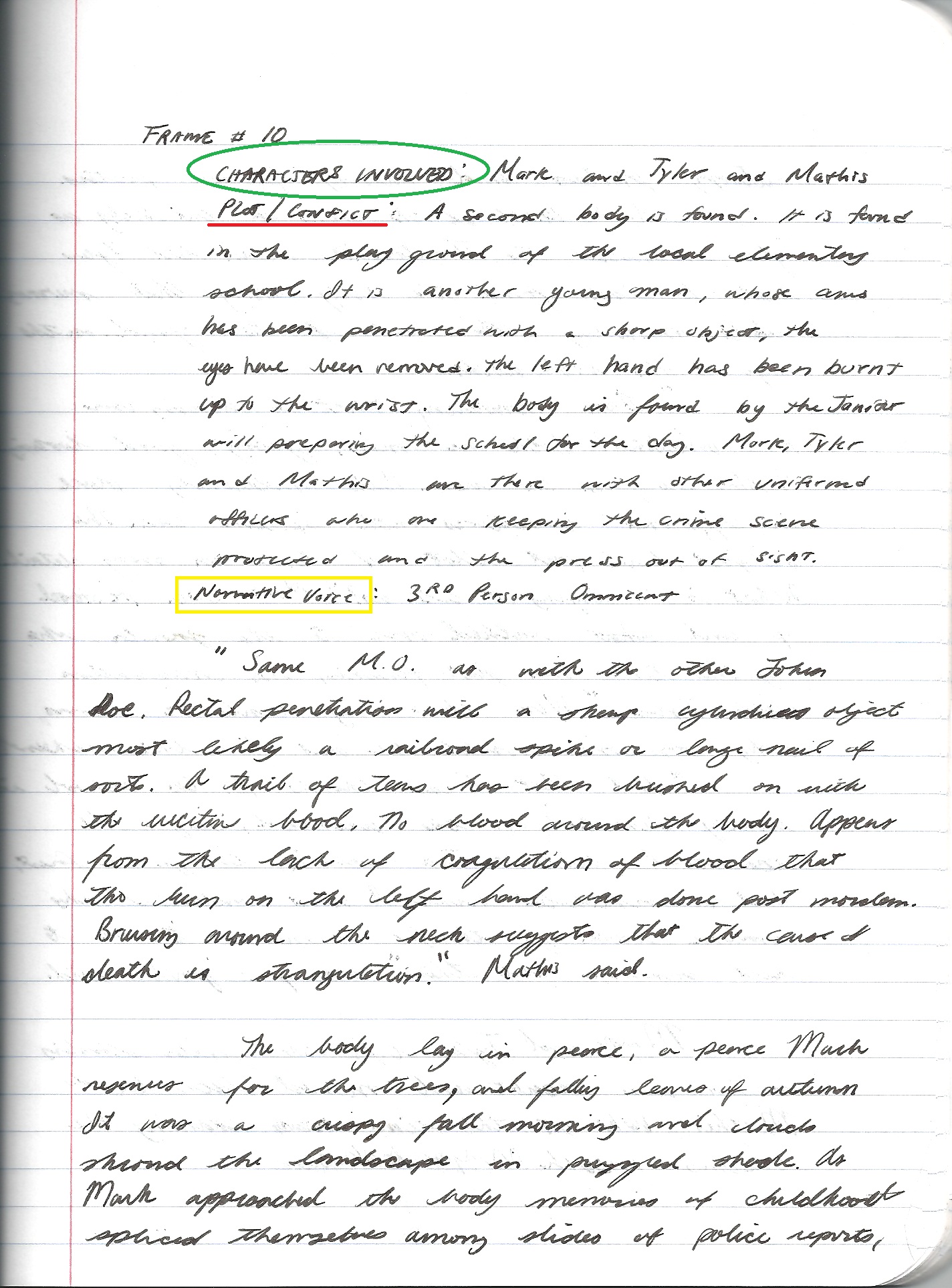
So below I have posted a photograph of what a page from my notebook looks like.


There are three key features that I would like to point out and each is marked by a different color and shape. Each color coded section refers to a different question I ask myself before I start any frame.

Who are the characters involved? What is the plot/conflict? What is the narrative voice?

By asking these questions I give myself a clear path to follow and it makes getting a few lines onto the page a little easier.

The first section, "Characters Involved" circled in green, helps not only to get you thinking about the who of a frame but allows you to group related frames quickly and easily.

The last section, "Narrative Voice" highlighted by a yellow rectangle, is important because it makes it explicit how the narrative is going to be told. In my frames I have used several narrative voices. For example Jacob's narrative is told in 1st person while Mark's narrative is told in 3rd person witness. I have also tried experimenting with narrative voices.

A new voice I am experimenting with is for William's narrative. I call it 1st person witness testimony (I'm sure there's some fancy literary term for this, but I'm a Law Student so please humor me). In this narrative voice there is no dialogue. Everything we get is from one person's mouth and by that fact hearsay. But what will make this narrative voice work will be the frames before this one. If I put frames before this that make William seem sympathetic then you will be more inclined to believe what he says. If I have a frame before this one where he is cheating on his wife, then you are less inclined to believe him.

The most important part of the Frame outline by far is the Plot/Conflict section underlined in red. This section helps me avoid writing meaningless details in the body of the frame which only serve to distract from the dialogue and narrative. This section also helps me to keep the pacing of the frame quick.

One additional benefit of writing out the Plot/Conflict before hand is that if I have to step away from my writing I already have a summary or rather an abstract of what the frame is going to be doing so I can quickly pick it up.

It' s important though to remember that just because you have outlined it in your Plot/Conflict section doesn't mean you have to follow it strictly in the body of the frame. The Plot/Conflict section is more of a guide to follow and is meant to help you. It should not be treated as though written in stone.

Remember, inconsistencies in your Frames are fine, and I would argue that they are preferable. These nuances and slight variations allow you to explore multiple ripples in the time/space fabric of your ever evolving world. These wrinkles will be ironed out in subsequent drafts so don't slow down your writing by trying to solve everything now.

Well, that's it for this week. Next time I am going to be finishing the second part of Framing and discussing how your Frames should work within their respective local narrative as well as the over-arching narrative.

Until next time,

As always

Undoubtedly Yours,

Bermuda the Man

Monday, April 9, 2012

A Novel Idea Part 3: Your Writing Road-map

My Fellow Contributors,

The novel is progressing and the characters are inviting me into their world. I am currently done with 30 frames of my 50 frame goal.

And with that I reach the topic of my blog this week: Having a plan of attack for your novel. Establishing a series of goals and checkpoints that allow you to mark tangible progress in your novel writing process.

But before I get into my writing road-map, I wanted to discuss how I am breaking away from the social norm of how most authors think about writing a novel. Where most authors see themselves as writing a book, I am going about it as though I am writing a screenplay.

A screen play has limited narration, simple stage directions and thus is mostly dialogue. This allows the director more freedom to create the film how he sees it and not how the writer envisioned it himself. Which sounds more user friendly given that in the Novel-land, the director is analogous to the reader and the screenwriter analogous to the page-writer.

When writing your first draft, I find this approach, putting less attention on the details and more attention to the character-narrative, not only more desirable but also healthier.

It is more desirable in the sense that you are able to get through many different frames without being bogged down in one particular part of the story. By not being concerned with every little detail of your narrative the first time through, you don't have to worry about contradictions that will inevitably show up through out the frames of your first draft as you get deeper and deeper into the local narrative. This type of drafting is also healthier than the traditional A to Z appoarch because you are able to amass a large amount of clay from which you can shape subsequent drafts. You don't get lost in a narrative and then end up giving up because you can't decided whether your heroine is wearing all black, or white lace and how this will impact the rest of the novel. You don't feel like you have to answer all of your Narrative's questions or tie up all of the loose ends in a given chapter.

REMEMBER:

Always leave more to write.


So now on to my road-map.

Like any long, continuous project, it is important to have goals. Not only does it give you a sense of accomplishment but it also gives you a way of holding yourself accountable. By giving yourself steps, you are more likely to make it to the next level, no matter what the endeavor.

My first goal is to get to 50 frames.

Why 50?

I chose 50 for several reasons. First, it gives me a large amount of clay to work with and shape. Second it was a large number that, while obtainable, would require dedication and commitment to reach. It should be noted that my novel will more than likely consist of more than 50 frames.

Frames are awesome Bermuda, but how long is it going to be? How many words do you have written?

A friend asked me these same questions and you know what, I told him this:

I have no idea.

And you know what else, I particularly dislike that way of thinking for a lot of reasons but the major one is because thinking about writing length in terms of word count is very demoralizing and limits yourself in the early stages of your writing process. I would much rather think of a goal in terms of writing frames rather than writing words. The smaller number of frames relative to the tens of thousands of words in a novel makes me feel like I can achieve my goals and makes the project seem less daunting. Another reason this way of this is detrimental is that it limits you. Don't worry about length, about making it this long or this short, just write until the narrative tells you she's all done.

Alright, Respect. So, what do you do when you have all your frames?

After I've finished the 50 frames, I am going to type all of them into my computer. As I mentioned in Part 2 of this series, the act of typing is in essence a revising step. Once all of the frames have been typed/revised, then each of the frames gets a title.

The title will then be placed on an index card. Much like a story board I will then place frames out until I have a straight forward narrative. This step is important because I don't write the frames in a linear fashion. Frame #23 and Frame# 24 for example are not apart of the same local narrative. By laying out each local narrative, I am able to see the holes or rather gaps in each of them. Once the gaps have been identified, I can begin the third draft which will consist for the most part of me filling the gaps in each of the three local narratives I have in the novel and shaping smooth transitions between frames of a given local narrative.

Once the local narratives have been laid out and frames have been added to plug the holes, all of the frames now get put on another round of flash cards same as before. Each with a title for the frame. This is where the magic happens. This is where you weave the three local narratives into your main over-arching narrative. This is where you will spend most of the time editing; moving this and that in an effort to create a tempo for your novel that maximizes the meaning.

Well that's it for this week, my Fellow Contributors.

REMEMBER: set goals for yourself that are obtainable and challenging. By breaking up your writing process into steps, you'll be surprised when your standing on top looking down on the world as they read your finished novel.

Next week I am going to be posting a picture of my actual notebook and going over the structure of a Frame. What should it include, what the structure is like, how long it should be and how it should function in relation to the local and main narratives.

As Always

Undoubtedly Your,

Bermuda

Tuesday, March 20, 2012

Building your Writing Toolkit: Part 5.3 – Pounding it Together: Making Narrative Work

As promised, I’m back with more on narrative, and this time I’ll actually be getting into a few specifics. Because I’m getting into specifics, this blog is about three thousand words long, and for that I have two things to say to you: I’m sorry; deal with it.

We’ve covered the fact that we all encounter narrative everywhere, and we’ve discussed that there are many forms that narrative takes, as well as many things you should and shouldn’t do to improve narrative in your writing. This week I’m here to talk about making narrative work in different written media – I’ll be covering narrative in poetry, fiction, academic and creative essays, and drama (briefly and badly – I’m not much of a dramatist.)

I decided to start with narrative in poetry because I have a lot to say about it. We at AFLM get a lot of poetry submissions, and sadly we have to reject a lot of poetry submissions. I want to give you aspiring poets an insight into one of the most common complaints we have about the poetry we reject – it goes something like this: “I liked a lot of images in this piece, and the language was good, but it just doesn’t say anything.”

I have this complaint about a lot of poetry: I’m not just complaining about the submissions we’re seeing, or the poems I hear in workshops, or the poems presented in creative writing classes – I’m bitching about the same thing on the poetry pages of The New Yorker and American Poetry and in poetry collections for the last twenty (at least) years. A prevailing attitude in poetry in the last few years has been that it doesn’t have to actually DO anything so long as it looks good doing nothing. This attitude is bullshit, and is roughly equivalent to cramming a Geo engine into a Maserati. If it’s crap, it’s crap, and no amount of chrome or styling will fix it.

I believe that poetry should always do something, say something, or reexamine something. Let’s look at one of the ballsiest poets we published, Ben Jefferson, who had the sack to submit a 9-word-poem to our magazine, and whom we published based on the sheer chutzpah of that submission. His poem “Eros and Psyche” goes like this:

“When Love gazed on Psyche
He fell into himself.”

What I like about this poem is that on the strength of allusion alone the nine words it’s made up of tell a story – Jefferson gets you to completely reexamine the whole of the Psyche myth (and hopefully the modern concept of psyche, the old concept of love, and by omission Narcissus) with a few words. Even though this poem is more clever than it is deep, it tells a complete story and asks for depth from its readers – and in nine words it does a hell of a lot more than 250 lines of purple verse that describe disconnected images to no purpose.

If you can maintain a similar effect over more than a few lines that's great. There's a reason that dear Uncle Walt is our poster boy - take a look through “Song of Myself” and experience not only a narrative, but an autobiography in poetry that reaches beyond the self and into a national consciousness. In other words, Father Graybeard was a master of narrative in poetry, so you should read more of his work - it can only help.

What makes Whitman fantastic in his use of narrative in poetry is his (mostly) delicate touch. Even though Whitman is a constant presence in “Song of Myself” he doesn’t impose himself on you with his voice, he allows you to get to know him through his vision. By way of contrast, in much of Poe’s poetry his narrative styling is too obvious to want to emulate (see "The Raven" as the most egregious offender) but Poe makes up for that by essentially creating mystery narrative right out of his ass, because he simply fucking felt like it.

Poe’s fiction is a good source to focus on for narrative because it is trying to do one very specific thing (creep you the fuck out) and it succeeds remarkably well. Poe’s characters are sometimes a little thin, his prose is frequently (brilliantly) overwrought, and his narrators are balls-out crazy, but just sane enough to hook you behind them and drag you screaming through his short fiction. Poe’s narration is personal because it’s trying to do one, excruciatingly hard thing (guarantee you have nightmares about mundane objects for the rest of your life) and that works best with a personal relation of the stories.

Twain, on the other hand, plays with his narrative style and voice a little more. Sure, you can hear the sardonic drawl of a semi-sleazy newspaperman bent on claiming all the world’s great one-liners in the background of almost every work, but go pick up The Adventures of Huckeberry Finn for a moment. Look at any passage where Huck is talking about Jim. The masterful blend of clarity and confusion in Huck’s vision of the world around Jim is the exact opposite of the narrative tone in nearly any passage about youthful misadventure that you’ll find in The Adventures of Tom Sawyer. Now look at something culled from Puddin’head Wilson, bonus points if it’s something about Roxy or her son, and see if you can spot the predominant attitude of the narrator (hint: while Twain manages to be sweet, salty, and sour in this story, it’s pretty clear that there are some things about which he can only be bitter.) If you’re looking for a golden boy in American Literature, you’re not looking for Twain, but if you want to see some adaptability in an author Samuel L. Clemens is certainly your man. Delicacy isn’t exactly his wellspring in most of his fiction, but he manages to be delicate with surprising adroitness when the situation calls for it. Kindness isn’t his bread and butter, but he can ditch the sarcasm to make a telling point when he needs to. I picked Twain here because he’s a pretty damn brilliant example of flexibility in narrative, and he happens to be only a century or so removed from modern readers.

If you want another, less literary, more contemporary, example of someone who can play narrative in novels like a fiddle, check out some Stephen King. In a lot of King’s books the narration follows the same pattern but in some (Gerald’s Game, The Eyes of the Dragon, Everything’s Eventual, It and most especially in The Bachman Books) King reaches into his methodology, strangles it a bit, and comes back with a way of telling a story that you’d never imagine coming from the man who wrote Christine, In a Buick 8, and the story that eventually became the awful movie Trucks, three pieces of fiction about homicidal cars.

Hold on a second. The man wrote three stories about murderous cars. And a story about murderous cell phones. Murderous rats. Murderous fog. Murderous governments. Murderous Gypsy curses. Murderous aliens. Scary-ass murderous clown-spider-alien things. Murderous alter egos. Murderous dead pets. When you really break it down, Stephen King has written the same story (“X” wants to kill you in the worst way imaginable) at least a hundred times. Really think about that. His books have topped bestseller lists for decades, he’s won the O. Henry award for short fiction, he’s written sweeping sagas and fantasy stories and the worst dreams in our collective consciousness (at least since someone put fangs and clown makeup on Tim Curry) and he’s done most of that by writing the Same. Basic. Fucking. Story. Over and over again. Never mind any disparaging comments I might have made earlier – this man has sold the same story to millions of people in dozens of books. He’s the fucking president of “People Who are Better at Long Format Narrative than Anyone You Know.”

Now that I’ve completely overawed myself by marveling at King’s immense body of narrative miracle working, I’m going to completely switch gears and go back to Twain. And I might as well totally turn the discussion in a different direction and start talking about essays. One of the best examples of narrative in critical essay writing that I’ve ever seen is Twain’s “The Literary Crimes of James Fenimore Cooper.” (If you haven’t read it I’ll give you a moment to go to Gutenberg.org, one of the best places on the internet, to download the complete Twain anthology that they have available absolutely free – it’ll only save us time in the end.) The “Literary Crimes” essay is some deliciously nasty literary criticism that also collects some of Twain’s finest opinionated vitriol on what was, essentially, the Twilight of the time. Twain’s narrative style throughout the piece is in-your-face, funny, cruel, and genuine. If you can pull this off in an essay for class then I tip my hat to you, because you’re a stupendous badass, but since I sincerely doubt that anyone reading this is as cool as Mark Twain I’ll expound a bit more on how to manage narrative in critical essays.

A lot of professors these days are lamenting the loss of the “I” in student essays. We’re trained from freshman year of high school that the worst word you can include in an essay is a self-referential personal pronoun, and so we tend to avoid it like the plague. I hate that attitude, and many professors do as well because when you use “I” well in an essay you convey greater conviction to your readers and you come across as someone who’s actually invested in your topic.

If you start an essay with “One has to wonder whether Stephanie Meyers had ever read a book before putting pen to paper,” you sound like a wishy-washy librarian. If you start an essay with “I’ve never encountered an author for whom I hold a greater loathing or more ill wishes than Ibsen,” you sound like a determined jerk (possibly a determined librarian jerk) – but you’ve hooked your reader. You hate Ibsen. You think he’s a jackass. You wish that all of his plays would dissolve into ash, and suddenly your reader wants to know why. Now, you can’t follow this up with “I hate Ibsen because I think he sodomized corgi puppies” and expect to be taken seriously by anyone, but if you follow up convicted “I” statements with numerous examples of sexism, stock characters, strained dialogue, and evidence of an utter lack of understanding of any human relationships, you’re on your way to earning some credit with your reader.

You have to be careful with narrative in academic papers – you’re trying to tell a story (i.e. the story of why Ibsen should die in a fire, the story of why Meyers is really just awful, the story of why summer vacation should be extended for at least a month, the story of Jane Austen as an early feminist) without sounding like you’re telling a story. You need to learn how to move through an academic paper in a natural way, introducing your reader to your topic (either slowly or shockingly) before supplying evidence and arguments (it helps to think of your arguments as characters – give them some personality, make them stand out, and use your evidence as setting to let them shine) and eventually reaching a conclusion that becomes inevitable as the narrative in your essay comes to a climax (inevitability is key here – surprise endings in academic essays are as ill advised as they are in romantic comedies; they’re proof of poor planning and generally a buzzkill.)

So that’s the academic side of essay writing – what about the creative side? Narrative in creative essays is perplexing. A lot of it depends on whether you’re writing about yourself or someone else, and what the purpose of the essay is. If you’re writing a creative essay about yourself then you should go to great lengths to tell your story the way you really would tell your story – seriously, record yourself telling the story, transcribe that recording and clean it up for publication. This will get you that much sought-after tinge of “authenticity” in creative nonfiction. If you’re writing about someone or something else your narrative should be shaped to showcase your subject – you are less important in this sort of essay than your subject is, but your opinion about what your subject says about the world is vital – tell the story the way you see it, but allow yourself to fade into the background (for how to do this, search me – I’m quite bad at this sort of thing – but take some cues from “Song of Myself” because, as mentioned above, Whitman was amazing at telling you how he saw the world by literally telling you about the things he saw in the world.)

Finally, I’m moving on to another topic I don’t know much about – narrative in drama. There are plenty of reasons I’m not the best source of advice on this subject, primarily the fact that I can’t stand live theatre, but I do have at least a couple of suggestions for you hopeful dramatists out there.

Drama is storytelling without the boring business of actually writing out all the crap that goes with a story. You’ve got dialogue and plot, and that’s really about it – even character is, to some extent, out of your hands and in the dubious grasp of the actors. So how do you make storytelling work if you’re not going to write, you know, an actual story?

Number one, for me, is chorus characters. I’m not talking about girls in stockings kicking dangerously high, I’m talking the about masked Greeks who used to stand on the sides of the stage and tell everyone what the hell was going on. Choruses haven’t been popular in the original sense in drama for quite some time now, but my favorite plays (read: the only plays I can really stand to read or watch) incorporate some chorus element. A fantastic example of this is Hamlet. Hamlet doesn’t run around with a bunch of dudes in sheets shouting out his plans over his shoulder – he does it himself. Hamlet’s soliloquies are his chorus – they tell you where the plot is going, why he’s thinking what he’s thinking, and they assure you (time and time again) that he’s not just batshit crazy. Want a different example? Oscar Wilde. In The Importance of Being Ernest Algy and Jack spend a lot of time vocalizing their plans, plots, motivations and ardent desires. This isn’t left up to the actors – you can’t trust the actors with this kind of stuff – Wilde wrote down all the pertinent narrative in what are, basically, superfluous speeches so that the audience could read more into the story than simply the action that was happening on stage. More examples? How about Tennessee Williams – is there any reason to provide all of the rehashings of character history unless it’s to fill in narrative gaps that are created by the lack of a narrator? Try a musical on for size – in Little Shop of Horrors the songs pick up a lot of the narrative duties, but not as much as the bloody she-bopping urchins, who step into the literal (and original) role of a chorus.

Another element that helps drama with narrative is setting – you can do this with words, like Shakespeare, Marlowe and most other Renaissance dramatists did (having your characters tell the audience that they’re on a battlefield, and how they’re shocked at the smoking ruin of war, works in building character as well as moving your story more into a story-telling realm) or you can do this with physical set changes and props (but you still need to tell people what room or forest or well they’ve walked into in order to suspend disbelief and keep your audience firmly ensconced in the story.)

I think I’ve run out of steam here, and said as much as I can reasonably (or unreasonably) expect anyone to read in a single blog. I’m going to leave off with the big question: what doesn’t work in narrative? A lot. You’ll find it, as you practice and grow in your writing. You’ll find that there are a lot of techniques that don’t work for you, and you’ll find many that do. But as you continue to write the field of “doesn’t work” will continually narrow as the field of “does work” continues to expand for you as a writer.

So long as you’re not Ibsen. Seriously. Fuck Ibsen.

Thanks for reading such a bloody long blog, and I’ll be back next week with exercises to improve your narrative technique, which should finish off my weeks-long exploration of narrative.

Until then, Cheers.

- Alli

Saturday, March 10, 2012

Letter to the Leaves: There is No Try, Only Do

My Fellow Contributors,

While researching the life of Charles Bukowski for our Facebook profile's "People of Character," I came across a quote that he had etched into his grave stone.

"Don't Try"

I was troubled at first glance, but as I researched more into his life, I found it strangely gratifying.

I mean, think about it. To try is to accept the fact that you might fail. But to do is to resist failure and leave her in the rear view mirror.

This reminded me of a few lines spoken by the famous fictional philosopher, Yoda, in The Empire Strikes Back.

"No. Try not. Do... or do not. There is no try"

I remember hearing these same lines, from my sixth grade Drama and Performing Arts teacher. The point she was trying to convey is that "to try" implies to the receiver of such a phrase that the sender is not fully confident and wants to give a sense of possible failure whether conscious of this intention or not.

The power of language to guide and shape our subconscious is without doubt. When Bukowski says, "Don't Try," he means do not set out to write great poetry or the next classic novel. Let it flow out of you. When we try we put up dams which block the flow of words. But when we let the Muses take over and let them guide our pens we find that we have uncovered something in ourselves that is mystic and cosmic. Something that doesn't even feel like us.

It's as if Milton and Ginsberg and Burroughs and Kerouac and Shakespeare and James and Howells and Twain and Emerson and Whitman and Poe and Hemingway and Sartre and Sedgwick and Dickinson and Austin have met in your mind to form an unctuous orgy in your unconscious, leaving their love children to berth themselves onto your page.

I find it strangely gratify to relieve myself on the page without trying. To relax and release and let go.

Remember as writers we're are a mixture of mediums.

1st is the writer who uses words to create clay.

2nd is the reviser who molds and shapes the clay into a form.

3rd is the editor who bakes and hardens the form into a sculpture.

4th is the publisher who displays the sculpture and shares it with love.

5th is the viewer who looks, reads, and touches. Appreciating art in all its minute nuances which strike with each sight.

Greatness comes not from the writer but from the reviser and editor.

Remember, just do it, think later.

But if you feel like you've hit a wall laced with writer's block, then please:

CONSIDER THE FOLLOWING:

You have to live vicariously in order to write interestingly.

And On the Road was written by Kerouac when he was 29, after he had lived through the lines he let flow onto that long continuous script.


As Always

Undoubtedly Yours,
Bermuda

Friday, January 20, 2012

Letter to the Leaves: The Literary Cannon Cigar Lounge -Members Only-

My Fellow Contributors,

If you have been following me on Twitter (@BermudaAFL) then you may have read that I am currently reading the Italio Calvino novel, If on a Winters Night a Traveler. This novel is unlike anything I have read during my time as an under grad. His manipulation of personal pronouns, the novel's self awareness and awareness of other has left me reading, re-reading, and discovering new nuances with each sitting.

But why has it taken me this long, almost four years, to come across a book that has sparked more classroom discussion than any other in my time at Cal Poly. A book that I have been motivated to read, not because of grades, but because of the desire to discuss it with my fellow colleagues outside of the classroom.

Looking back on the courses I have taken, they were filled with good books from various time periods. However I feel as though I have been trapped in the 18th, 19th and very early 20th century for four years.

What has been missing from my literary education are authors who have yet to be given the members-only key to the literary cannon cigar lounge.

Where Walt gently selects a cigar from the box at the bar and delicately places it in his mouth, before Henry James grabs his book of matches and begins to light him up. Where Milton and Edwards are debating nature's place in divinity, and Shakespeare is on stage, skull in hand, spouting forth a dramatic monologue (To be or not to be...). Where Equiano trades tales with Cabeza De Vaca and over in the corner Bradstreet and Dickinson are quietly abstaining.

I am there, only as visitor. Shuttling from one author to the next, ease dropping on conversations, catching the punch line of a joke here or choking on the smoke from a Whitmanian aphorism there. In all this haze and muted chatter, I struggle to find meaning. But with the guidance of my professor, who at this time is heaving haughty laughs with Franklin, I sift my way through the leaves of ash, and find a purpose.

But where is Ernest Hemingway, Hunter S. Thompson, Tennessee Williams, Anthony Burgess, and Gabriel García Márquez? (to name a few)

They're outside. Waiting for the critic/bouncer, who stands at the door, to give them their key. You can see them through the sounds and smoke, peering over his shoulder, staring at you.

Beckoning you to say a word on their behalf.

As Always,

Undoubtedly Yours,
Bermuda

Sunday, November 27, 2011

Just When I Thought I Had Outgrown You

This Thanksgiving break I had the pleasure of visiting my family in Northern California. We ate turkey (too much), caught up on each others' lives, and, most importantly, got out the Christmas decorations. All of these events where fun and memorable, but, now that I have returned to Southern California, the experience that I find myself returning to most during the break was a run in with one of my old high school teachers; the teacher who inspired me to become an English major.


Here is a bit of back story before we begin: Up until junior year in high school I hated writing. It was tiresome, burdening, and restrictive. Now let me explain. Before junior year the majority of English classes which I took where pre-examined, predefined courses, and the essays which were required in the courses revolved around proving a theme that the teacher had already picked out for you. I was not prompted to think critically, I was not asked for my own opinion, I was just asked to think as my teacher did and demonstrate why my teacher's said theme was prominent in the story. Well, needless to say, I did horribly. Why? Because I was bored.


Junior year, however, was new. I decided to take honors English that year and, even though I begged my mom to let me drop the course, it turned out to be one of the best decisions of my life. This teacher didn't like to hear himself reiterated in the essays which he assigned. In fact, he hated it so much that he would mark us off for doing it. I can remember thinking after receiving the first blog prompt that the printer must have failed. The prompt was much too short. It merely stated something along the lines of: pick a theme you feel prominent in Samuel Beckett's “Waiting for Godot” and reveal how this theme functions throughout the story. I was inspired. My boredom was over and I felt a sense of freedom which I never before had felt in school. That quarter I fell in love with writing, I fell in love with reading, and I fell in love with literature. That love has only continued to bloom as I have furthered my education into college.


But that is the past. Moving forward, I had a run in with this teacher, and this run in was something that I had wished would happen for some time now. I had imagined that the greatness I had seen in him was due to the lack of knowledge that I possessed, and, like most aspects of life revisited after growing up, I expected to be let down. I was not however. The education that I have received thus far in college only spurred our conversations further. As we navigated from Wordsworth to Whitman, from Ovid to Arthur I now found myself keeping up. Picking up on things that he would say that I would not have during my high school years. It was a great experience and made me realize that certain aspects of life, such as a conversation with a past instructor, are only made better with the more knowledge that we possess. Though I was able to have much more involved literary conversations with this teacher, I was still impressed with the amount of knowledge that he possessed and I continued to learn from him throughout our interaction.


It seemed that fortuity was on my side that day. As I came home my mom was digging through an old box of books so I sat down next to her and helped her look through them. During our dig I came across my childhood favorite book: The Ear, The Eye, and The Arm by Nancy Farmer. Seeing that I had just had the recent run in with my high school teacher I took my finding of the book as more than coincidence and decided that I would sit down and read the book to see if I would still find it great, though I had not read it in over ten years. And let me tell you, it was. My love for this book could have possibly been driven by the nostalgic euphoria that fell over me as I soared through the pages, but I would like to believe that it was more than that. The entire experience was unique and new because, though I found myself enjoying much of the same parts of the book that I had when I was a child, I also found myself intrigued by so many new sections that I had not fully understood as a kid. I picked up on allusions that I was not aware of and found meaning that was not apparent during my readings ten years before. During this reading, the book morphed into something new, while still preserving the roots that the 11 year old version of myself had grown so close to.


So what am I saying? I am telling you to try it. Think back. What was your favorite book as a child and when was the last time you read it? Go and find this book and reread it and decide for yourself if it is still worth the praise it received from you as a child. So take a step back and give it a try. You never know what you might find.


-Nick